NJ Pest Guard Blog, October 2026
Carpenter Ant Damage vs Termite Damage in NJ: How to Tell Them Apart
Short answer: carpenter ants leave clean, smooth galleries and piles of sawdust-like frass, while termites leave mud tubes and wood hollowed out and packed with soil. Both swarm in spring, but swarmers look different and treatments differ completely.
Why the distinction matters
But treatment differs completely: ants by locating the nest, termites with soil barriers or bait systems.
Both pests love moisture-damaged wood — the starting point for most infestations from Fort Lee, Wayne, Clifton, and Paterson.
What carpenter ant damage looks like
Carpenter ants do not eat wood; they excavate it. A colony chews smooth, clean galleries into wood for its nest, pushing debris out through small kick-out holes. That debris is frass, the best carpenter ant clue: fine sawdust or wood shavings, often mixed with bits of dead ants.
Inside, carpenter ant galleries feel smooth and sanded, almost polished, with no soil packed in. Damage usually follows the grain in damp or soft wood: window frames, door frames, deck boards, and sill plates near leaks.
What termite damage looks like
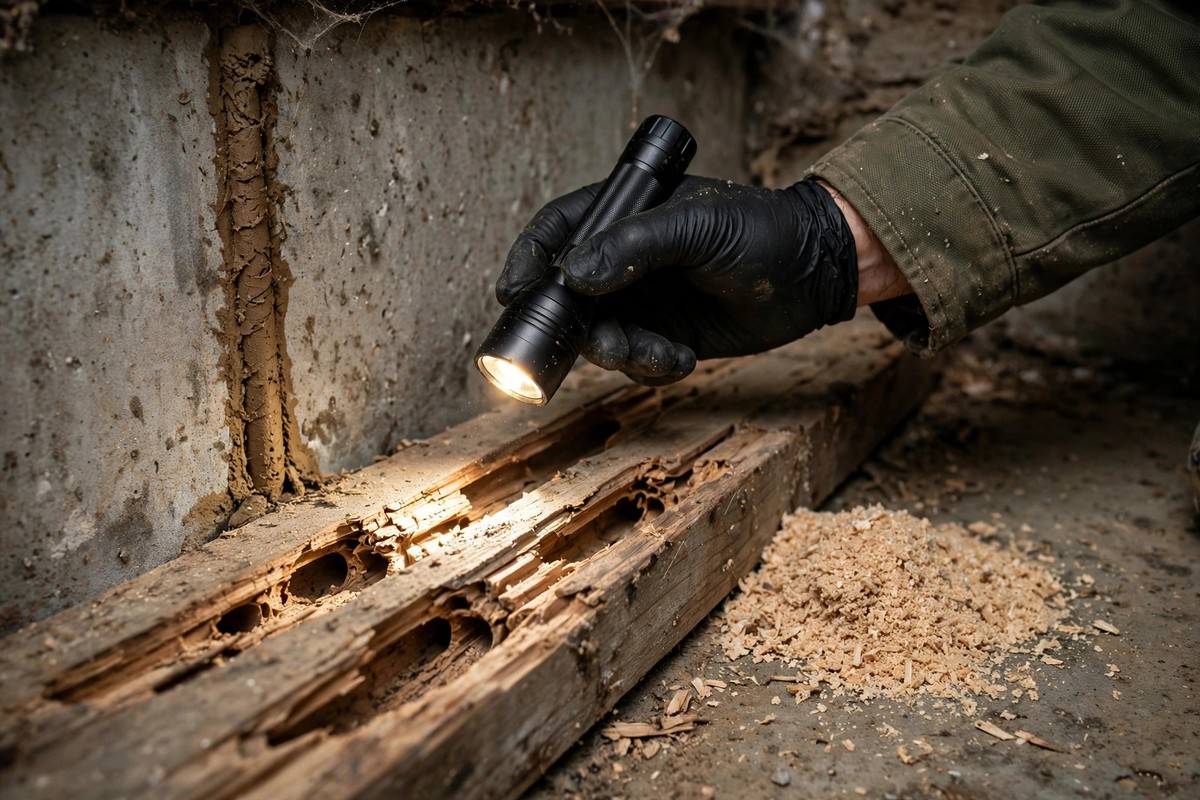
Termites do eat wood, specifically its cellulose, and Eastern subterranean termites, behind nearly all NJ termite damage, live in soil and travel to your house through it. Their signature sign is the mud tube: a narrow, pencil-width tunnel of soil and saliva running up a foundation wall, sill plate, or crawl space pier, protecting termites from drying out as they travel between soil and framing.
Inside, termite damage looks very different. Galleries are rough and packed with soil and mud, and the wood often looks layered or honeycombed, with thin surfaces that crumble when pressed. Termite-damaged wood sounds hollow when tapped, and a screwdriver can sometimes push straight through a board that looks fine. If you see mud tubes, leave some intact for the technician.
Swarmers: the springtime confusion
Both pests swarm in spring, and both swarmers end up dead on windowsills — which is why homeowners mix them up. Look closely: termite swarmers have straight antennae, a thick waist, and two pairs of equal-length wings. Carpenter ant swarmers have elbowed antennae, a pinched waist, and longer front wings.
Found Damaged Wood or Swarmers?
Do not spray first — it can scatter the colony. Let us identify it.
(973) 653-8456Tap to call nowWhat to do when you find damage
First, do not panic and do not reach for a hardware-store spray: it kills the few you can see and drives the colony deeper, making treatment harder.
Third, fix the moisture. Both pests target damp wood, so a leaking gutter, grade sloping toward the foundation, or slow plumbing drip often invited them in. A treatment that ignores moisture will need repeating. Finally, get an inspection: a technician can identify the pest from the gallery pattern, frass, or tubes in minutes, and the plan follows. Homes in Edgewater, Cliffside Park, and Fort Lee see both pests regularly — same rule everywhere.
The bottom line
Frass and smooth galleries mean carpenter ants. Mud tubes and soil-packed, hollowed wood mean termites. Equal-length wings and a thick waist mean termite swarmers; pinched waists and uneven wings mean ants. Either finding deserves prompt inspection; both pests only get more expensive with time. Unsure? A free inspection settles it first.
Not Sure Which Pest You Have?
Free inspections — pest and source identified first.
(973) 653-8456Tap to call nowCarpenter Ant vs Termite Damage FAQs
What does carpenter ant frass look like?
Carpenter ant frass looks like fine sawdust or wood shavings, often mixed with bits of dead ants. It piles below kick-out holes and reappears after sweeping if the colony is still active.
What do termite mud tubes look like?
Termite mud tubes are narrow, pencil-width tunnels of soil and saliva running up foundation walls, sill plates, or crawl space piers, protecting termites from drying out between soil and wood.
Can carpenter ants cause as much damage as termites?
Carpenter ants hollow out wood for nesting but do not eat it, so damage usually progresses more slowly than termite damage. Left alone for years, a large colony can seriously weaken beams and framing.
How can I tell a carpenter ant swarmer from a termite swarmer?
Termite swarmers have straight antennae, a thick waist, and two pairs of equal-length wings. Carpenter ant swarmers have elbowed antennae, pinched waists, and longer front wings.
What should I do if I find damaged wood in my NJ home?
Do not disturb the area or spray it — that can scatter the colony and make inspection harder. Note what you found and book a free inspection so a technician can identify the pest first.